
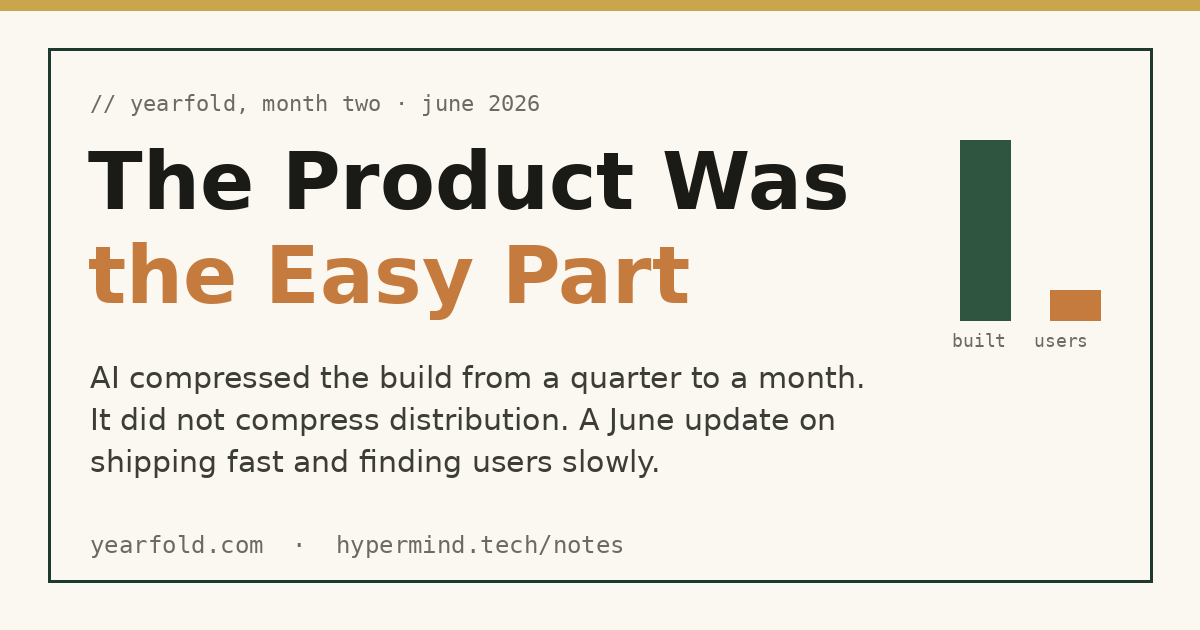
In May we built Yearfold — a free retirement calculator that runs 10,000-path Monte Carlo simulations — from a name in a document to a live product in thirty days (the full May case study is here). June was month two, and month two taught us the lesson every founder eventually writes about, usually with the same slightly stunned tone we are about to use: building the product was the easy part.
We do not say that to be cute. We say it because it is the most economically important thing we have learned all year, and because AI made it dramatically more true than it used to be. The build compressed from a quarter to a month. The users did not compress at all. This post is the honest June ledger: what shipped, who showed up, what LinkedIn did and did not do, and how we are rethinking outreach for a product that works but is not yet found.
The build kept sprinting
Let us get the comfortable part out of the way first, because it is genuinely remarkable and it is also the setup for the punchline. In June, the same one-spec, AI-assisted, gate-everything method that built the site in May shipped what would historically be a couple of quarters of roadmap: a full Pro subscription tier — monthly plan re-runs with narrated changes, a tax deadline calendar with reminder emails, an AI copilot that answers questions about your own plan by calling the real simulation engine, bracket and IRMAA watchlists, dynamic spending guardrails that compute an annual retirement paycheck. A Couples tier for household planning — survivor analysis, Social Security timing optimization across two people, healthcare-bridge math for retiring before Medicare. An embeddable mini-calculator that publishers can drop into articles. A cluster of comparison pages for people evaluating alternatives. A free sample of the paid PDF. The automated test count crossed eight hundred.
Velocity, in other words, was not the problem. At no point in June were we blocked on engineering. Read that sentence again, because five years ago it would have been absurd, and it is the entire reason the rest of this post matters: when AI removes the build bottleneck, whatever bottleneck is next in line becomes your whole company. Ours, it turns out, is attention.
Who actually showed up
Here is the funnel, in the only honest units available at this size — rounded shapes rather than precise counts, because a chart with four users on one bar is noise pretending to be data.
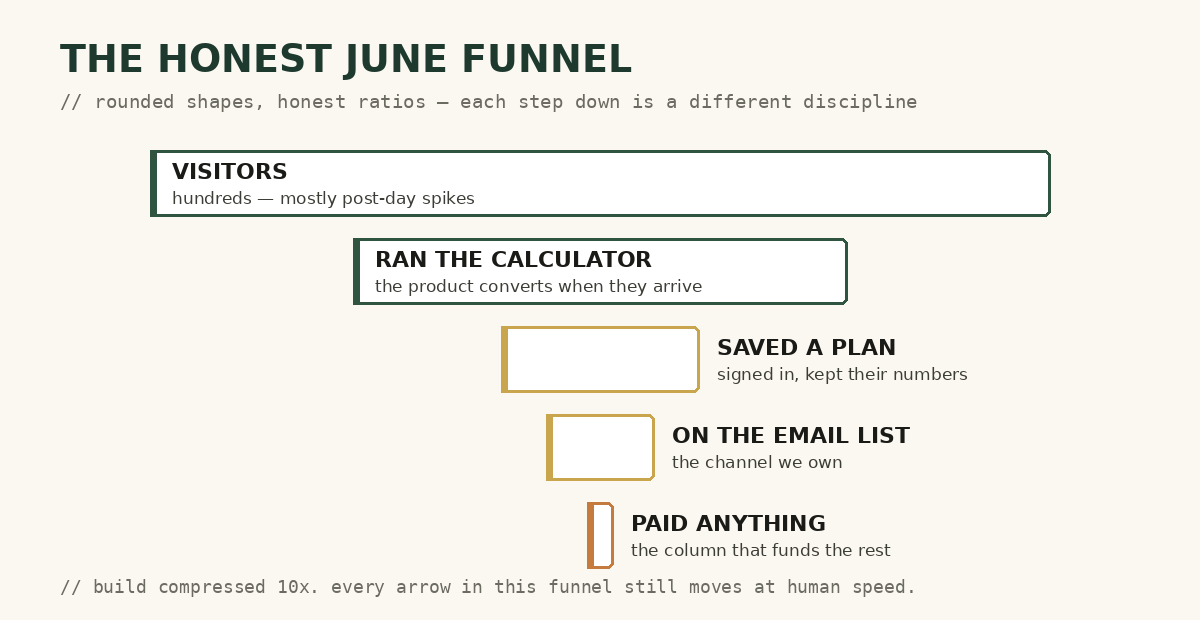
Visitors in the hundreds, not the thousands. Of those who arrived, a healthy share actually ran the calculator — the product converts curiosity into use just fine, which is the one genuinely encouraging line in the ledger. A smaller group signed in and saved a plan. A smaller group still is on the email list. And the paying column can be counted without taking off your shoes.
Two readings of that funnel are available. The pessimistic one: two months of intense work, a product objectively better than most of what ranks on page one for its queries, and barely anyone knows it exists. The accurate one: every conversion ratio inside the funnel is fine — the problem is entirely at the top. People who find Yearfold use it. Almost nobody finds it. That is not a product problem. It is a distribution problem, and distribution is a different job with different skills, and nobody compressed it with a language model yet.
What LinkedIn did — and what it could not
The one channel that has produced measurable results is the build-in-public posts on LinkedIn. Each one — the launch story, the engine deep-dive, the honest updates — brought a real wave: profile views, comments from people who actually tried the calculator, a handful of saved plans we can trace to post days, and several genuinely useful conversations, including bug reports we fixed the same week. For a channel that costs nothing but writing time, that is a real return, and we are grateful for every reader who clicked through.
But the shape of that traffic tells its own story, and the shape is a heartbeat monitor.
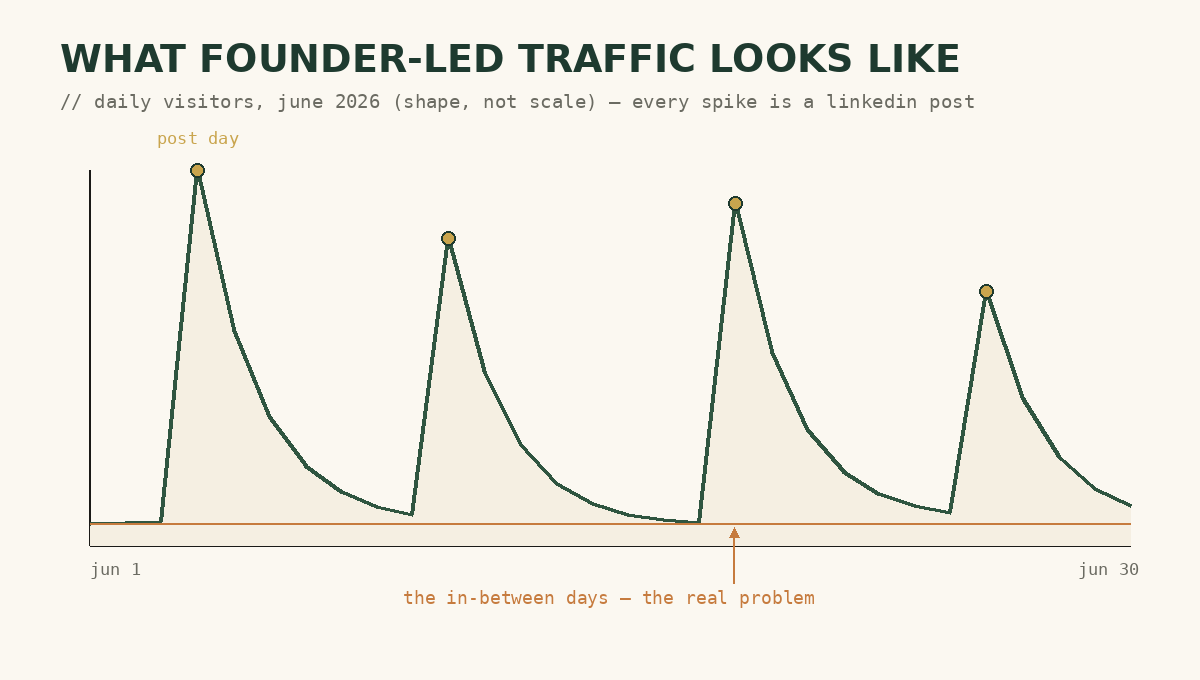
A post goes out, traffic spikes for a day, decays for two more, and returns to a baseline that rounds to quiet. The spikes are real people — but they are largely the same network seeing the same author, and a personal network is a finite reservoir. Founder-led content is working exactly as well as it can work. It is a spark plug, not an engine. The compounding channels — search, referrals, embeds, word of mouth — are planted but young: the SEO cluster is weeks old on a domain with no authority yet, indexing is trickling in, and backlinks so far can be counted on one hand. Search will pay rent eventually; it will not pay it this quarter.
So we are saying the quiet part at normal volume: Yearfold does not have many users right now. The product is live, fast, honest, and free, and most days the analytics chart is a flat line with a pulse. If you have ever shipped something you were proud of into silence, we now understand that feeling from the inside.
What the few taught us anyway
Small numbers still teach, and June's early users changed the product in ways a thousand anonymous visitors would not have. A commenter's confusion about account types became plainer labels and a live "adds up to your total" helper in the calculator wizard. Hesitation we heard about paying $9.99 for a PDF from a site nobody knows — entirely reasonable — became the free, ungated sample PDF, generated by the exact paid pipeline so nobody has to trust a screenshot. Two people asked, in different words, "what happens to my plan when the rules change?" — which is half the reason the Pro re-run features exist at all.
This is the counterintuitive gift of a quiet launch: with tens of users instead of thousands, every conversation is legible, and we answered every one personally. There is a version of this company that never gets that intimacy again. We are trying to bank it while it lasts — every early user who feels personally heard is a future referral with a story attached.
Why builders get this backwards (we did)
It is worth being precise about the mistake, because it is a thinking error, not an effort error — and AI just made it much easier to commit.
Building is a domain where feedback is instant and merit is legible. Write the code, run the tests, green or red, ship. Every hour invested shows up as visible progress, and with an AI agent the exchange rate on those hours is spectacular. Distribution is the opposite domain: feedback is delayed by weeks, merit barely matters at the start, and most actions produce nothing visible. Post, pitch, submit, comment — silence, silence, silence, then one day a trickle. Given the choice between a domain that rewards you every hour and one that ignores you for a month, a builder will choose building every time and call it work, because it is work. It is just not the work the product needed most.
The classic advice — build the audience before the product — was easy to nod at and easy to skip when the product itself took a year. When the product takes a month, skipping it becomes the dominant cost of the whole venture. Our May retrospective bragged that the constraint had moved from typing speed to decision speed. June's correction: past launch, the constraint moves again — from decision speed to attention, and attention is bought with months of unglamorous showing-up that we should have started in April. The practical consequence for July is a hard reallocation: the build gets two days a week, and it will complain, and the other three go to the work below.
The outreach plan for the summer
So here is what we are actually going to do about it — written down publicly, partly for accountability and partly because this list is the transferable artifact for anyone else staring at their own flat line.
Keep the heartbeat, widen the artery. The LinkedIn cadence continues — it is the only proven channel — but each post now has a job beyond reach: point at one specific durable asset (a calculator scenario, a comparison page, the methodology) so spikes deposit something that search can find later.
Show up where retirement anxiety already lives. The people who need a 10,000-path simulation are asking questions in personal-finance communities, comment sections, and newsletters right now, using none of our keywords. The plan is participation before promotion: answer real questions with real math, disclose the affiliation plainly, link only when it genuinely helps. Communities smell drive-by marketing instantly; they tolerate a practitioner who does the arithmetic.
Put the widget to work. The embeddable mini-calculator was built precisely for this: personal-finance bloggers get a free interactive tool for their articles, and Yearfold gets placement and a backlink — distribution that compounds instead of decaying. July's job is unglamorous: a list of fifty writers, fifty personal emails, and the thick skin to hear nothing back from forty of them.
Ask for the coverage directly. A "Show HN"-style launch, pitches to the retirement and FIRE newsletters, and the two or three podcasts whose audience matches exactly. Each is a lottery ticket with better odds than silence.
Let the product recruit. Results pages now share properly with a preview card, and saved plans quietly generate an annual "your plan, re-run" email. Small loops, but they are the kind that work while we sleep, which founder posting demonstrably does not.
Measure outreach like we measure code. The same discipline that gates every merge now gates every week of marketing: a Friday scorecard, one number per channel — posts published, emails sent, replies received, backlinks earned, search impressions. Not because the numbers will be good yet, but because "we did some outreach" is exactly the kind of unfalsifiable status report we would never accept from engineering. A channel that produces nothing for six honest weeks gets deprecated like any other failed dependency.
What we are deliberately not doing: paid acquisition. Finance keywords are among the most expensive on the internet, and buying traffic before organic conversion is proven is a way to turn a distribution problem into a distribution problem plus an invoice.
The uncomfortable, useful conclusion
Here is the June thesis, stated once without hedging. AI has made building so fast that a working product is no longer meaningful evidence of anything. The moat was never the code; now it is not even the shipping. What remains scarce is exactly what was always scarce — trust, attention, and the patience to earn both — and the builders who internalize that before their launch month will beat the ones who, like us, learned it from a flat analytics chart in June.
The product, meanwhile, keeps being good, which is the one advantage patience can compound. If you are within a decade of retirement — or you just want to see what ten thousand simulated futures say about your number — yearfold.com is free, it takes five minutes, and it will tell you the truth even when the truth is a 61% success probability. Run it, and if it earns it, tell one person. That, we have learned, is currently worth more to us than a feature.
If you're facing this
If you have shipped something good into silence — or you are about to, because the AI-assisted build went faster than your distribution plan — we are living the same chapter in public and comparing notes freely. And if your company's version of this is an internal tool nobody adopted, that is the same disease with a different logo; adoption is a practice we run for clients. Either way, get in touch — we reply within one business day.