
Last month we wrote about OpenClaw three weeks into its improbable rise — the triple rename, the ten-second handle heist, the fake token, the fastest-starred repository in the platform's history. February was the circus. March is the part that actually matters, and it is a quieter, heavier story: the month the industry stopped arguing about a viral toy and started arguing about a category. Because somewhere in the noise, the thing everyone was running crossed a line that chat products never did. It stopped answering questions and started doing the work.
That sentence sounds small. It is the whole story. For three years "AI" in most people's hands meant a text box: you ask, it answers, you copy the answer somewhere and do the actual task yourself. OpenClaw's popularity dragged a different model into the mainstream — an agent that takes a goal, makes a plan, reaches into your real tools, and acts, then checks its own work and tries again. This post is about that shift, why it happened in public rather than in a lab, what the March security reckoning revealed about the cost, and what a company should actually do now that "AI agent" means something with its hands on the controls.
The line it crossed
Here is the distinction that the whole month turned on, drawn as plainly as we can.
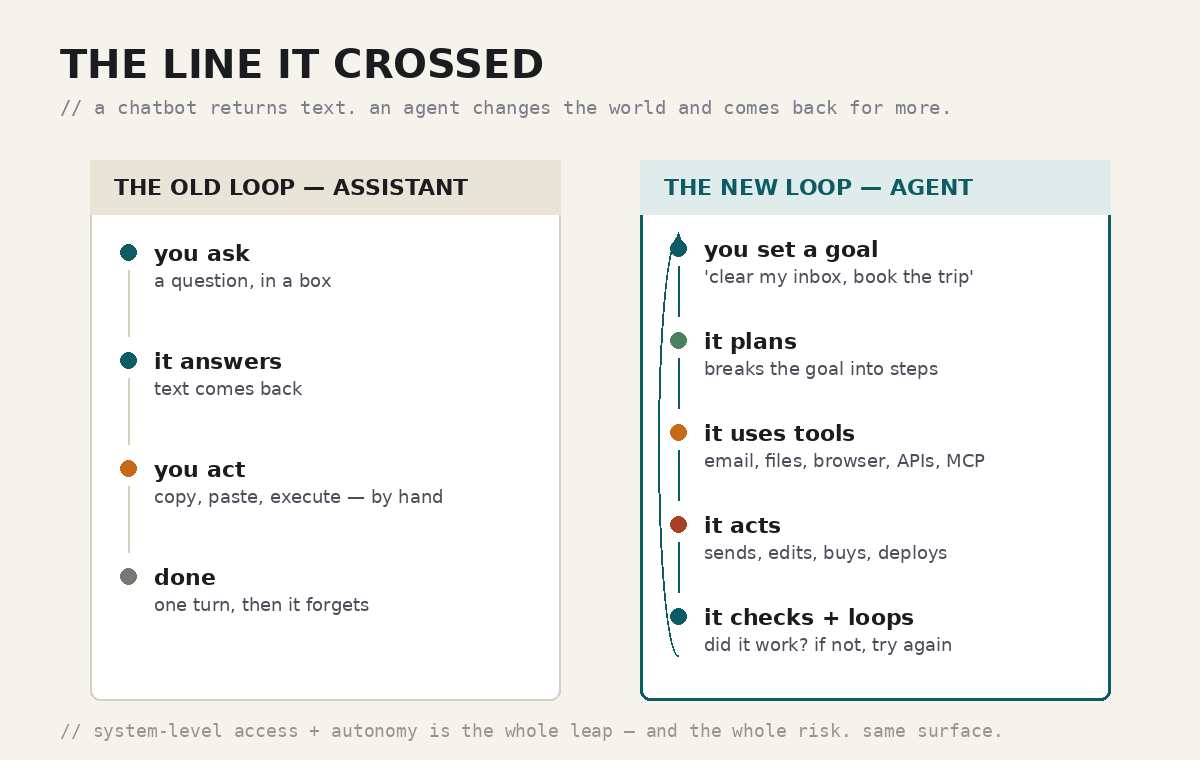
The old loop is a conversation. You ask a question, text comes back, and every consequential action — sending the email, editing the file, placing the order — is yours to perform by hand. The model is a very well-read colleague who can only talk. The new loop is delegation. You hand over a goal — clear my inbox, reconcile these two spreadsheets, book the trip within this budget — and the agent decomposes it into steps, calls whatever tools it needs, takes the actions, and loops back to check whether the goal is actually met. When it fails, it notices and retries rather than waiting for you to notice.
The mechanism that makes this possible is not a smarter model. It is access. When a frontier model is plugged into OpenClaw, it is granted reach into the host machine's files, browser, applications, and network, plus a growing catalogue of external tools through the Model Context Protocol — the emerging standard that lets one agent connect to servers for email, calendars, code repositories, analytics, publishing, and more. People are running agents wired to dozens of those tools at once. The agent is no longer a brain in a jar answering trivia. It is a brain with hands, standing in the middle of your actual systems, allowed to pull the levers.
That is the leap the entire enterprise world spent March absorbing. And it is worth saying clearly, because the marketing blurs it: the reason this is transformative and the reason it is dangerous are the same fact. System-level access plus autonomy is the whole capability and the whole risk, on one surface.
Why enterprises leaned in anyway
You might expect a month of security headlines to cool enterprise interest. The opposite happened, and the reason is that the value proposition is not subtle. An agent that can act, unprompted and continuously, is not a better chatbot — it is a category of work that did not exist in software before.
The concrete patterns that surfaced across March are unglamorous and exactly why they stick. Agents watching a product-analytics stream in the background and pinging an account manager the moment a customer's behavior shifts — no human asked, the agent just noticed. Agents that take "turn this quarter's numbers into the board deck" and pull the data, draft the slides, and leave a reviewable result. Agents doing the tedious connective tissue of a knowledge worker's day: triaging the inbox, updating the tickets, chasing the missing document, filing the report. None of these tasks is individually hard. What is new is that nobody has to sit at the keyboard while they happen.
There is a deeper reason the timing landed now rather than a year ago, and it is not only the model quality. It is that the plumbing finally standardized. A year ago, wiring an AI to your calendar, your code, and your CRM meant a bespoke integration for each — weeks of glue code per tool. The Model Context Protocol collapsed that into a common socket, so an agent that speaks it can reach a new tool the moment someone publishes a server for it. Capability stopped being gated by integration effort. That is why a personal side project could suddenly touch a hundred systems, and why the enterprise version of the same idea went from "someday" to "this quarter" almost overnight.
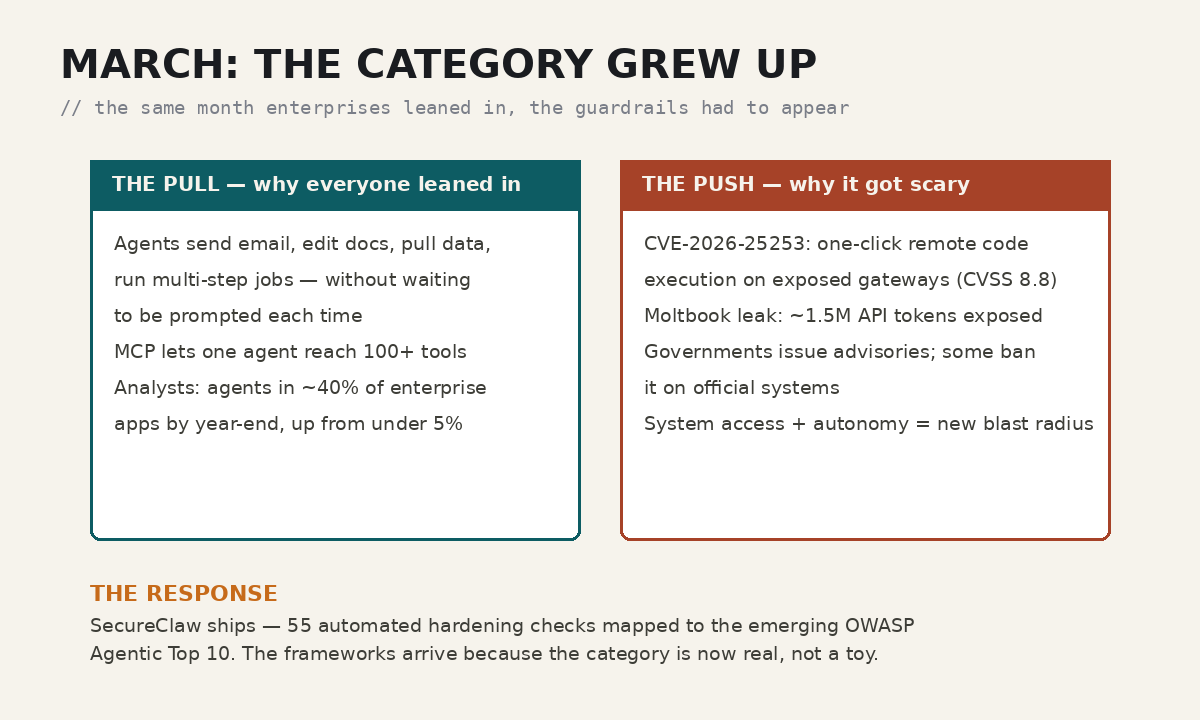
The analyst framing that made the rounds is worth repeating with appropriate caution: forecasts now put AI agents inside something like forty percent of enterprise applications by the end of the year, up from under five percent a year ago. Treat the precise number as a directional guess, not gospel — these projections are always generous. But the direction is unmistakable, and OpenClaw is the artifact that made it visceral. A CIO could dismiss a research report about "agentic AI." It is harder to dismiss the fact that your own engineers are already running one at home and asking why they cannot have the governed version at work.
Why the same month got scary
And it did get scary, on schedule, because a tool that can act is a tool that can act wrongly at machine speed.
The headline vulnerability of the season was a one-click remote-code-execution flaw — catalogued as CVE-2026-25253, rated high severity — in which the agent's control interface trusted a gateway address handed to it in a URL without checking it, letting an attacker who got a single click turn a personal agent into a foothold on the machine it ran on. It was patched quickly, but the exposure it implied did not go away: internet scanners kept finding OpenClaw gateways sitting on the public internet, reachable, in dozens of countries. On the adjacent Moltbook social network — the agents-only platform we described last month — a database misconfiguration left something on the order of a million and a half API tokens and tens of thousands of email addresses exposed to anyone with a browser. Not a sophisticated breach. A door left open, at a scale only a viral product reaches.
Governments noticed. Through late February and into March, official advisories accumulated warning that default or careless OpenClaw deployments carried serious risk, and at least one national government moved to keep it off official systems entirely. When ministries start issuing notices about a two-month-old side project, the side project has become infrastructure.
The through-line connecting the enthusiasm and the alarm is the one we keep returning to: an agent's usefulness is proportional to its access, and its danger is proportional to the exact same access. You cannot have one without the other. Which is why the most important development of March was not a vulnerability at all. It was the arrival of the guardrails.
The category grew up: guardrails arrive
Categories become real when the safety scaffolding shows up, and March is when it did. The security community produced the first purpose-built hardening tooling for OpenClaw — an open-source auditor that runs dozens of automated checks against a deployment and maps them to an emerging, formal taxonomy of agent-specific risks. That taxonomy itself is the tell: the industry began converging on an "agentic security" top-ten — a structured list of the ways an autonomous, tool-using agent gets abused (prompt injection through the content it reads, excessive permissions, unsafe tool use, and the rest) — analogous to the checklists that eventually tamed web application security. When practitioners start writing the numbered lists, the wild-west phase is ending.
The project's own governance hardened in parallel. The March release cycle pushed users toward a vetted, first-party plugin channel and began deprecating the informal skill-sharing that the ClawHavoc supply-chain attack had exploited in February — the campaign that planted hundreds of malicious "skills" in the community marketplace. Under its new foundation stewardship, with backing from a major lab, the incentives finally pointed toward boring, load-bearing work: signed packages, marketplace vetting, a real disclosure process. We said last month that the foundation's first jobs should be the dull ones. March is when it started doing them.
This is the arc that makes March the substantive chapter. February was a product going viral. March was a category being born — capability, catastrophe, and countermeasure arriving in the same four weeks, which is exactly the compressed sequence every genuinely new technology runs through, just usually over years instead of a month.
What this means for your company
Strip away the lobster mascot and the crypto drama, and OpenClaw is a preview of a decision every organization now has to make deliberately, because the technology arrived whether or not anyone was ready. Autonomous, tool-using agents are going to touch your systems. The only choice is whether they do it under governance or in the shadows.
The instinct to ban is understandable and, on its own, wrong — a blanket prohibition delivered by memo just moves the agents onto personal machines that also happen to touch your data, which is the worst of both worlds. The instinct to embrace uncritically is worse. The defensible posture is the one we have argued for through every wave of this kind, and it maps cleanly onto what March taught: decide, in writing, what an agent is allowed to do without a human in the loop, and make anything that moves money, sends messages as a person, or deletes data a gated action — permanently, not until the demo goes well. Scope every agent's access to the minimum tools and permissions the job actually needs, because an agent with your full credentials and a public port is not a productivity tool, it is a remote administration service with a personality. Treat the tools and skills an agent can reach as untrusted supply chain, because that is precisely what ClawHavoc proved they are. And give the curious a sanctioned path — a sandbox, a lab, a governed internal pilot — so the enthusiasm builds something you can see instead of something you find out about after an incident.
That last point is the strategic one. The demand is real and it is not going away, because the productivity is real. The companies that win the next two years will not be the ones that banned agents or the ones that let them run wild. They will be the ones that built the boring machinery — the permission model, the approval gates, the evaluation harness, the audit trail — that lets an agent's doing be trusted the way a chatbot's answering never had to be. That machinery is unglamorous, it is most of the work, and it is exactly the practice we run for clients.
March 2026 will be remembered, if the timeline holds, as the month the personal AI agent stopped being a demo and became a fact of organizational life — hands on the controls, for better and worse. The technology is early, the guardrails are earlier, and the direction is not in doubt. The task now is to meet software that acts on its own with governance that was designed for it, rather than borrowed from an era when the machine could only talk.
If you're facing this
If your team is somewhere between "our engineers are quietly running agents" and "leadership just asked what our position is on autonomous AI" — that gap is the whole conversation, and it is the one we have every week. We help organizations build the governed version of what OpenClaw did in the wild: agents that can act, with the permissions, gates, and monitoring that make acting safe. Get in touch — we reply within one business day.