
The Agent Operations Playbook — OpenClaw & Hermes, Under Control
Open-source agent platforms like OpenClaw and Hermes can research, draft, schedule, update systems, and chase routine work on a loop. The opportunity is real; so is the risk. This is how we scope the work, constrain the tools, and run the loop like production software — the outline, not the full engagement.
The demos are everywhere: an agent that runs your SaaS, an OpenClaw gateway pointed at your whole desktop, Hermes firing scheduled skills on a loop. On a laptop they work for a week. Then they stall — no tenancy story, no approval path for a customer email or a CRM write, and nobody accountable when the loop burns tokens or takes a wrong action.
This page is the generic version of how we turn that hype into day-to-day operational leverage: pick the right agent stack, wire it to real workflows, and ship it under control. The proprietary part — the workflow-selection judgement, the exact tool-scoping, the eval sets and the runbooks — is the engagement. What follows is the skeleton, enough to see the shape and decide whether to talk.
The opportunity, and the trap
Agents that take actions — not just answer — can absorb a real slice of a team's day: inbox triage, research briefs, status updates, CRM hygiene, recurring reports. Delegated well, that work stops needing a human at the keyboard. That is the opportunity, and it is genuine.
The trap is that the same power is the same risk. An agent with broad tool access, weak identity, and no evals is an unmanaged intern with production credentials. The value was never installing the agent — it is scoping the work, constraining the tools, and running the loop like software you can operate. That distinction is the whole engagement.
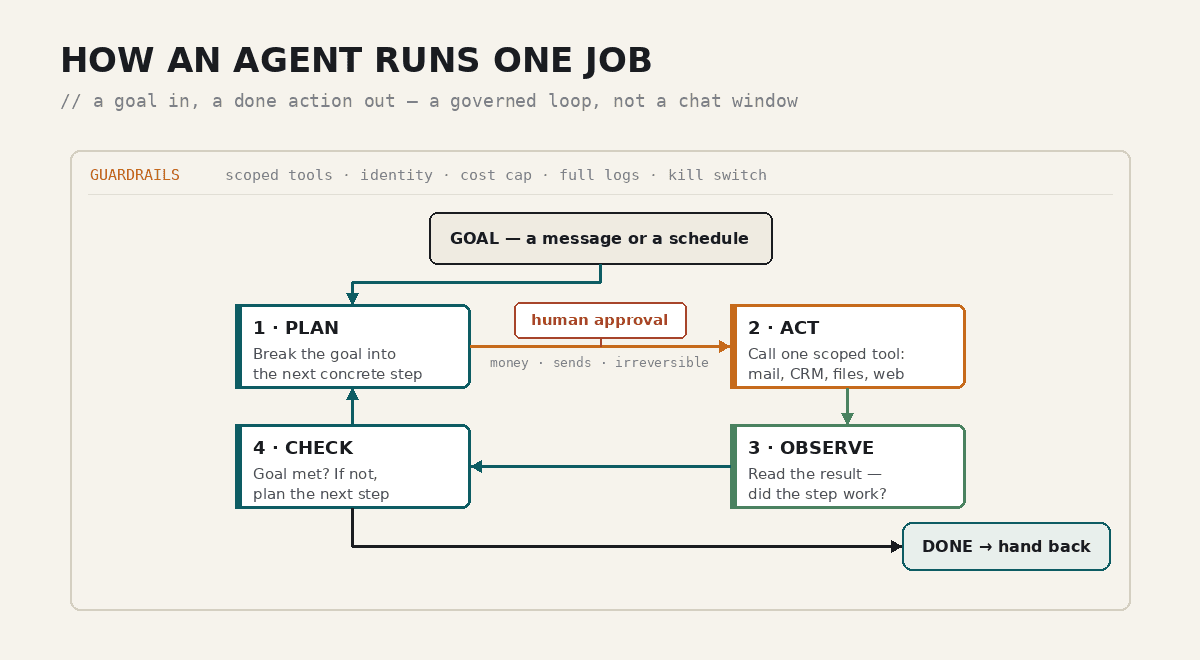
The mechanism
An agent does one job as a loop: take a goal, plan the next concrete step, call one scoped tool, observe the result, check whether the goal is met, and repeat until it is. Triggered by a schedule or a message, it runs that loop without anyone watching — which is exactly why the loop has to be wrapped in controls.
So we put a human-approval gate on the consequential steps, cap what each tool can reach, meter the cost, log every action the model proposed versus what actually shipped, and keep a kill switch one click away. The agent is autonomous inside a fence you designed, not loose on your systems.
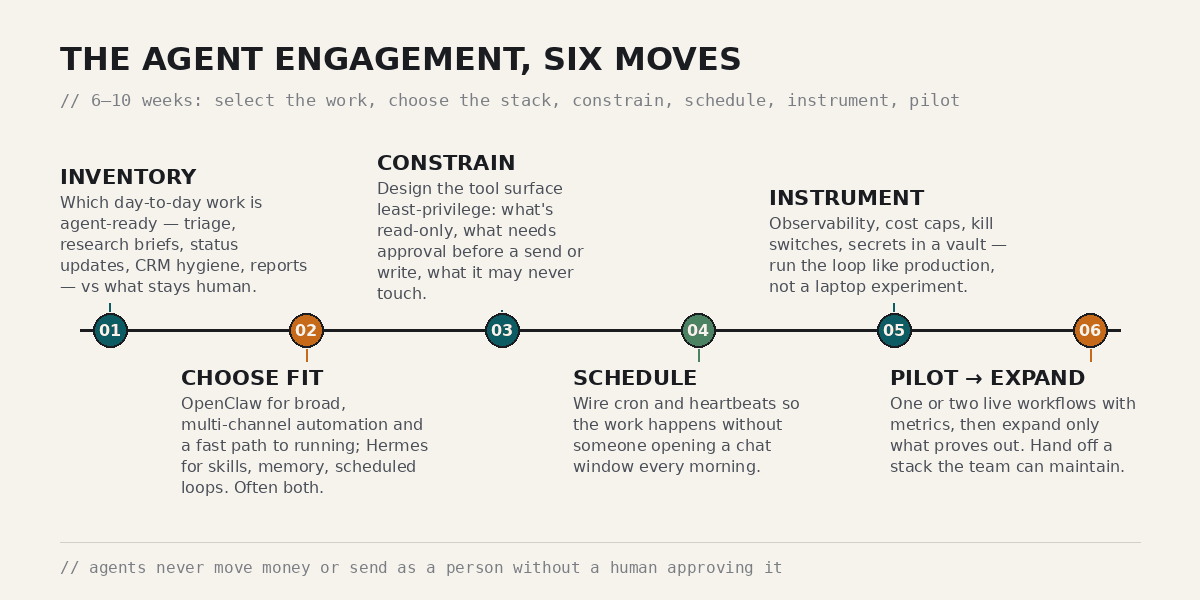
The engagement, six moves
The stages are deliberately unglamorous. The value is in how each is run — which work is agent-ready, how the tools are scoped, what the evals check — which is the part we bring. The outline:
Inventory the work
We separate day-to-day activities into agent-ready (inbox triage, research briefs, status updates, CRM hygiene, recurring reports) versus what must stay human. Nothing gets automated before this map exists.
Choose fit, not fashion
OpenClaw when a broad, multi-channel automation gateway and a fast path to running matter; Hermes when multi-agent skills, persistent memory, and tighter scheduled loops fit better — often both, in complementary roles. It is not a single-platform religion.
Constrain the tool surface
We design least-privilege access: which APIs the agent may call, what is strictly read-only, and what needs human approval before a send or a write. The blast radius is decided on paper, before the agent runs.
Wire the schedule
Cron jobs and heartbeats so the work happens on its own — not only when someone opens a chat window every morning. Recurring work becomes a background service, not a manual ritual.
Instrument and fence it
Observability, cost caps, kill switches, and secrets in a proper vault — not a .env file on a founder's laptop. Plus evals so a change to a prompt or a tool cannot silently regress the behaviour.
Pilot, then expand
One or two live workflows with success metrics — hours saved, cycle time, escalation rate — then expand only what proves out. We design, ship, and hand off a stack your team can maintain; fractional support after go-live is optional.
OpenClaw or Hermes? Fit, not fashion
We choose per workload, and frequently run both — each doing what it is strong at.
- The task is broad, messy, multi-channel automation
- A quick path from idea to running matters
- One gateway needs to reach many tools and surfaces
- General reasoning across a desktop / estate is the point
- You want a familiar, widely-used agent runtime
- Multi-agent skills and delegation fit the work
- Persistent memory across runs genuinely helps
- Scheduled, repeatable skills are the core need
- A tighter, faster execution loop matters
- The job is specific and well-defined, not exploratory
How the steps earn the outcomes
Agents handling a defined set of day-to-day activities on a schedule — with humans reviewing exceptions instead of doing every step — come straight from the inventory (which work), the scheduling (so it runs itself), and the human gate (so exceptions, not everything, reach a person). A clean split of labour between OpenClaw and Hermes comes from choosing fit over fashion in move two rather than betting the whole program on one platform.
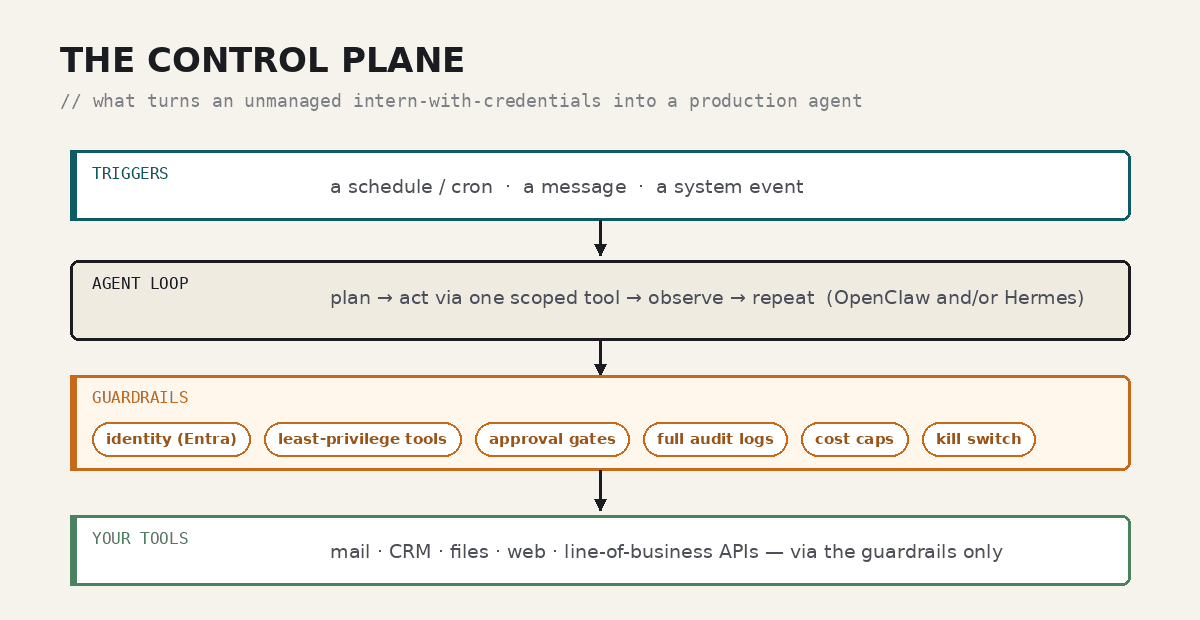
The security and ops baseline — approvals, logs, identity, and an owner who can disable the agent without a war room — is the control plane above, applied from the first pilot. And a path your internal team can maintain is the handoff: runbooks, named owners, and cost caps, so what we ship is an operational asset, not a dependency on us.
The guardrails, stated plainly
No agent moves money, sends a message as a person, or takes an irreversible action without a human approving it — permanently, not until the demo goes well. Every tool is scoped to the minimum it needs; read-only stays read-only. Secrets live in a vault, identity runs through your existing estate, and every run is logged and cost-capped with a kill switch in reach.
This is the difference between an agent you trust on real work and one you find out about after an incident. It is applied from the first pilot, not bolted on once something has already gone wrong.
What you actually get
By the end of a first engagement, you hold:
- A map of which day-to-day work is agent-ready — and what deliberately is not
- The right stack chosen per workflow (OpenClaw, Hermes, or both), with the reasoning
- One or two live agent workflows running on a schedule, under approval gates
- A security and ops baseline: identity, least-privilege tools, logs, cost caps, kill switch
- Evals and runbooks so a change cannot silently break behaviour
- A stack your team can operate — with optional fractional support, not a required retainer
Common questions
Is it safe to give an agent access to our systems?
Only with a control plane, which is the point of the engagement. Every agent runs least-privilege, through your identity, with approval gates on consequential actions, full logging, cost caps, and a kill switch. An agent with broad access and no guardrails is exactly what we are hired to prevent.
OpenClaw or Hermes — which should we use?
It depends on the work, and often the answer is both. OpenClaw suits broad, multi-channel automation with a fast path to running; Hermes suits multi-agent skills, persistent memory, and scheduled loops. We choose per workflow rather than making a single-platform bet.
What happens when the agent gets something wrong?
It should fail safe, not fail silently. Consequential actions sit behind a human approval, everything the agent proposes is logged against what actually shipped, and a kill switch disables it without a war room. Exceptions go to a person; the routine work keeps running.
How long until it is doing real work?
A typical first engagement is roughly six to ten weeks: inventory and stack selection, constraining and scheduling, then a pilot on one or two live workflows with metrics before anything expands.
Will we be locked into you to keep it running?
No. We design, ship, and hand off a stack your team can maintain — runbooks, named owners, cost caps. Fractional support after go-live is available if you want it, never required to keep the lights on.
Which of these hours could you get back?
Send a brief of your most repetitive office work. We will tell you honestly which parts are automatable, which are not, and what a first pilot would cover.