
The Tenant-to-Tenant Weekend Cutover Playbook
Friday you are two companies; Monday the acquired firm is live in the parent's Microsoft 365 tenant — mail under the new identity, historical email and files available, the old tenant no longer where work happens. This is how we make the weekend boring: the outline, not the full runbook.
A deal closes on a fixed calendar. Now there are two Microsoft 365 tenants, two identity directories, overlapping SMTP domains, and a leadership expectation that reads: after the weekend, we are one company — not six months of dual-tenant purgatory where everyone has to check the other mailbox.
This page is the generic version of how we deliver that: identity, mail, and files moved so that people log in to one tenant on Monday with their history intact. The proprietary part — the exact identity-mapping method, the pre-stage tooling choices, and the minute-by-minute cutover runbook — is the engagement. What follows is the skeleton, enough to see the shape and decide whether to talk.
The problem, in plain terms
Two tenants cannot quietly become one. Identities have to be re-homed, an SMTP domain can only live in one tenant at a time, mail has to keep flowing, and years of email and files have to arrive on the other side — all without a multi-week window where half the company works in the wrong place.
Leadership will tolerate a short, planned freeze over a weekend. They will not tolerate weeks of 'it's in the old tenant, log in over there.' The whole job is compressing the risky part into a controlled window — and that is almost entirely a function of what you did in the quiet weeks before.
The mechanism
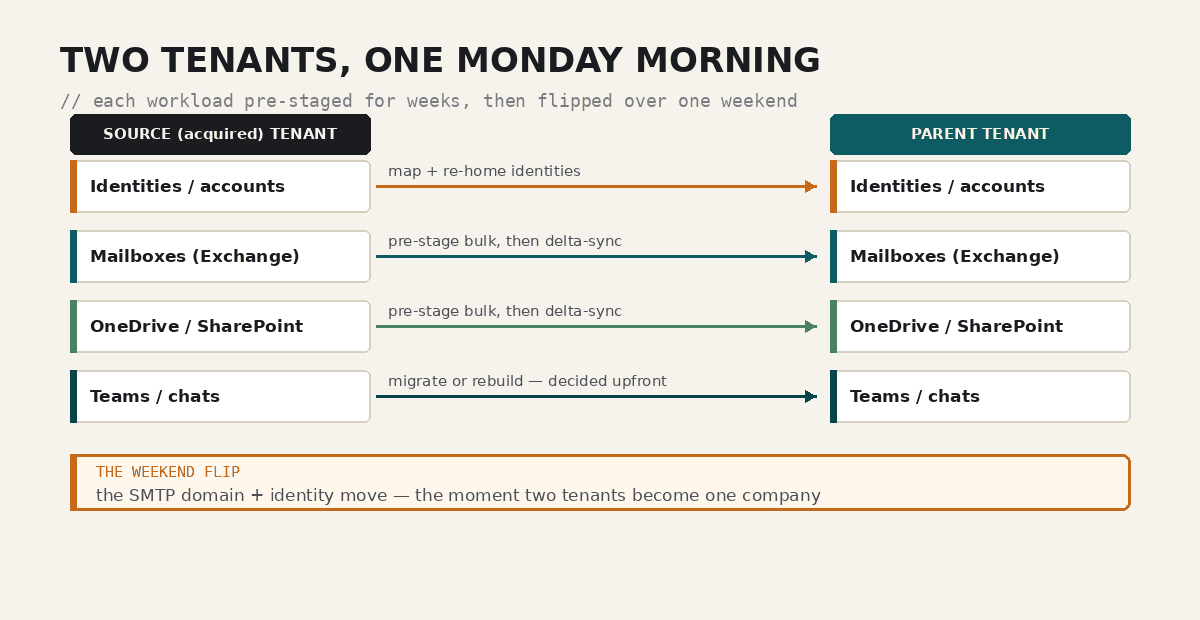
Every workload moves the same way: pre-stage the bulk of it into the target tenant over the weeks before, so the weekend is a small delta plus the identity and DNS flip — never a cold copy of years of data. Mailboxes and OneDrive/SharePoint content are pre-seeded and kept warm; Teams and collaboration surfaces get an explicit migrate-or-rebuild decision made upfront, not improvised.
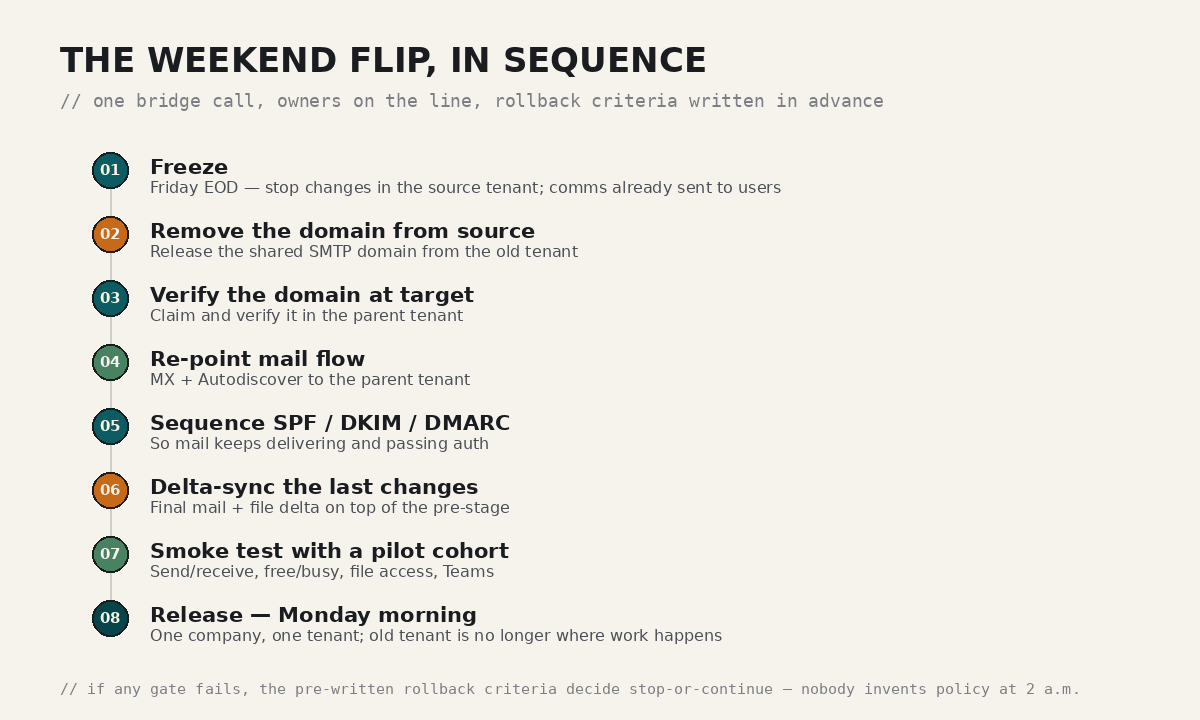
The weekend itself is the flip: release the shared domain from the old tenant, verify it in the new one, re-point mail flow, sequence the mail-auth records, sync the final delta, smoke-test, and release. Because the heavy lifting already happened, the user-visible part is a short planned freeze.
The engagement, six moves
The stages are deliberately methodical. The value is in how each is run — the identity mapping, the pre-stage tooling, the exact cutover sequence — which is the part we bring. The outline:
Lock the plan weeks ahead
Treat the weekend as a flip, not a discovery window. Inventory, identity mapping, UPN and SMTP plan, and coexistence rules are all agreed in writing before anyone touches production.
Pre-stage the content
Bulk mailbox and OneDrive/SharePoint data is seeded into the target tenant ahead of time, so the cutover is a delta plus DNS and identity — not a cold copy of years of history under time pressure.
Build the cutover runbook
A minute-by-minute domain runbook: remove the domain from the source, verify at the target, and sequence MX, Autodiscover, SPF, DKIM, and DMARC — each step with a named owner on a bridge call.
Test in pilot cohorts
Mail flow, free/busy, file access, and Teams are proven on a small pilot group before the whole company goes. Teams and SharePoint paths (migrate vs rebuild) are decided explicitly, not on the night.
Ship the comms pack
Before Friday close of business, every user has plain-English guidance: what changes Monday, what stays the same, where old mail lives, and who to call.
Write rollback criteria
Even when the plan is commit-forward, the stop-or-continue rules are written in advance — so the bridge room is executing a decision, not inventing policy at 2 a.m.
Done before Friday — vs — done on the weekend
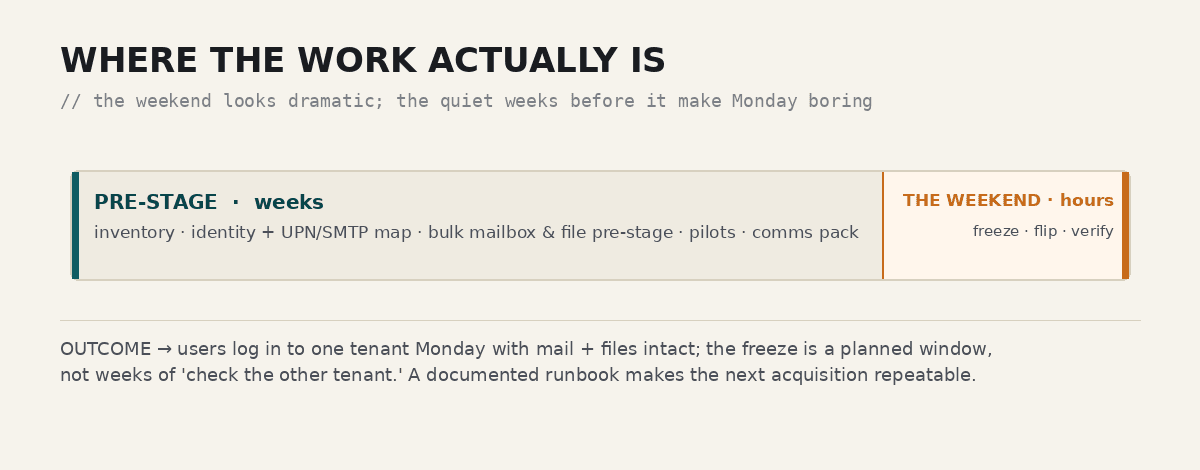
The split is the whole strategy: move everything that can move early, so the risky window is short.
- Inventory and identity / UPN / SMTP mapping
- Bulk mailbox pre-seed into the target tenant
- Bulk OneDrive / SharePoint pre-stage
- Teams migrate-or-rebuild decision, made upfront
- Pilot-cohort testing of mail flow and free/busy
- The end-user comms pack, shipped before Friday
- Freeze changes in the source tenant
- Release the SMTP domain and verify it at target
- Re-point MX / Autodiscover; sequence SPF / DKIM / DMARC
- Sync the final mail and file delta
- Smoke-test with a pilot cohort
- Release — one company, Monday morning
How the steps earn the outcomes
Acquired-company users authenticating and working in the parent tenant Monday morning comes from the identity mapping and pre-stage: their accounts are re-homed and their content is already there, so the weekend just flips the domain and syncs the delta. Historical email and files being available on day one — not 'we'll migrate archives later' — is a direct result of pre-staging the bulk instead of copying cold.
Disruption limited to a planned weekend window is what the pre-stage discipline buys: the risky part is compressed into hours because the heavy lifting already happened. And a playbook documented for the next acquisition means the second deal is the same stages with a different seat count — the repeatability is the point.
What you actually get
By the end of the engagement, you hold:
- A written cutover plan: identity map, UPN/SMTP strategy, and coexistence rules
- Bulk mailbox and file content pre-staged into the target tenant
- A minute-by-minute domain cutover runbook with named owners
- Pilot-tested mail flow, free/busy, and collaboration paths
- An end-user comms pack shipped before the freeze
- Pre-written rollback criteria — and a reusable playbook for the next M&A move
Common questions
How much downtime will users see?
A short, planned weekend freeze — not weeks of dual-tenant limbo. Because the bulk of mail and files are pre-staged, the user-visible window is the identity and domain flip plus a final delta sync, timed for a weekend so most people never notice.
Will we lose any email or files?
The goal and the design is no surprise data loss. Content is pre-staged and verified before the cutover, a final delta captures last-minute changes, and historical mail and files are available on the target side Monday morning — not deferred as an 'archives later' surprise.
Why does it take weeks if the cutover is one weekend?
Because the weekend is only boring if the weeks before it were thorough. Inventory, identity mapping, bulk pre-stage, pilot testing, and the comms pack are where the risk is removed. The dramatic weekend is a thin slice of the actual work.
What about Teams, SharePoint, and shared files?
Those get an explicit migrate-or-rebuild decision made upfront, tested with a pilot cohort — not improvised on the night. The right call depends on how the two organizations actually collaborate, which we scope during planning.
Can you do this for more than one acquisition?
Yes — the first cutover produces a documented playbook, so subsequent M&A moves are the same stages at a different seat count. Serial acquirers get faster and more predictable each time.
Which of these hours could you get back?
Send a brief of your most repetitive office work. We will tell you honestly which parts are automatable, which are not, and what a first pilot would cover.